📁 Local Offline Media & Files
Stored in your repository📄 Slide Deck Viewer
Viewing Lecture 1 Slides (PBIO lecture 1.pdf)📋 Course Organization & Grading Milestones
Key requirements presented by Prof. Adam KuzdralińskiLecture 1 · Synchronized Timeline
⚡ Interactive Bio Lab & In-Browser Python Simulator
Experiment with biological sequences in real time. Calculate thermodynamic GC content, visualize Watson-Crick duplex pairing, simulate in-silico Central Dogma transcription and translation, master biological vs Python 0-based coordinate slicing, query live UniProt REST APIs, and simulate data science pipelines.
🧬 Live Sequence Workbench
Reactive DNA / RNA / Protein analysis engine📐 Biological (1-based) vs. Python (0-based) Slicing Sandbox
Eliminate off-by-one errors visually (Lecture 3 Slide 14)
Drag the sliders below to slice a biological feature. Notice how biological coordinates are 1-based and closed $[start, end]$, whereas Python slicing is 0-based and half-open seq[start-1 : end]!
🌐 Live UniProtKB REST API Fetcher
Real-time HTTP retrieval from rest.uniprot.orgTest programmatic REST API queries right in your browser. Enter any valid UniProt accession number or click a preset to query live JSON metadata and functional annotations:
📊 Python Data Science & Matplotlib Simulator
Lecture 3 Slides 38–41: Sequence distributions & tablesSelect a data pipeline scenario to execute in-browser:
# Python Pipeline Output Console
>>> Running scenario 1: Protein length distribution
>>> Loaded 250 reviewed human protein sequences
>>> Mean length: 482 aa | Median length: 395 aa (Right-skewed distribution)
>>> Rendered publication histogram to Canvas.
🔬 Complete Exercise 1 Solutions & Rationale
Tasks 1.1–1.5 Breakdown:
- Small Molecules vs Macromolecules: Water ($H_2O$) and ions are small molecules; Nucleic acids (DNA/RNA) and proteins are linear polymers. Lipids form large aggregates (bilayers) but are not linear covalent polymers.
- DNA Building Block:
dAMP(2′-deoxyadenosine monophosphate). Features a phosphate group, 2′-deoxyribose sugar, and adenine base. - Cellular Structure: Bacteria lack nuclei (prokaryotes); eukaryotic cells house DNA in a membrane-bound nucleus and have mitochondria.
Key Principles:
- FASTA Format: Line 1 starts with
>followed by identifier and optional description. Subsequent lines hold the raw sequence. - Sequence Identity Formula: $$\text{Identity} = \frac{\text{Matching positions}}{\text{Total positions compared}} \times 100\%$$
- Sample A vs Sample B (12 bases): Positions 4 (
CvsT) and 10 (CvsT) differ. Matches = 10 / 12 = 83.3%. - Uncertain Base 'N': Means an ambiguous nucleotide. It represents genuine uncertainty in sequencing and cannot be eliminated by recalculation.
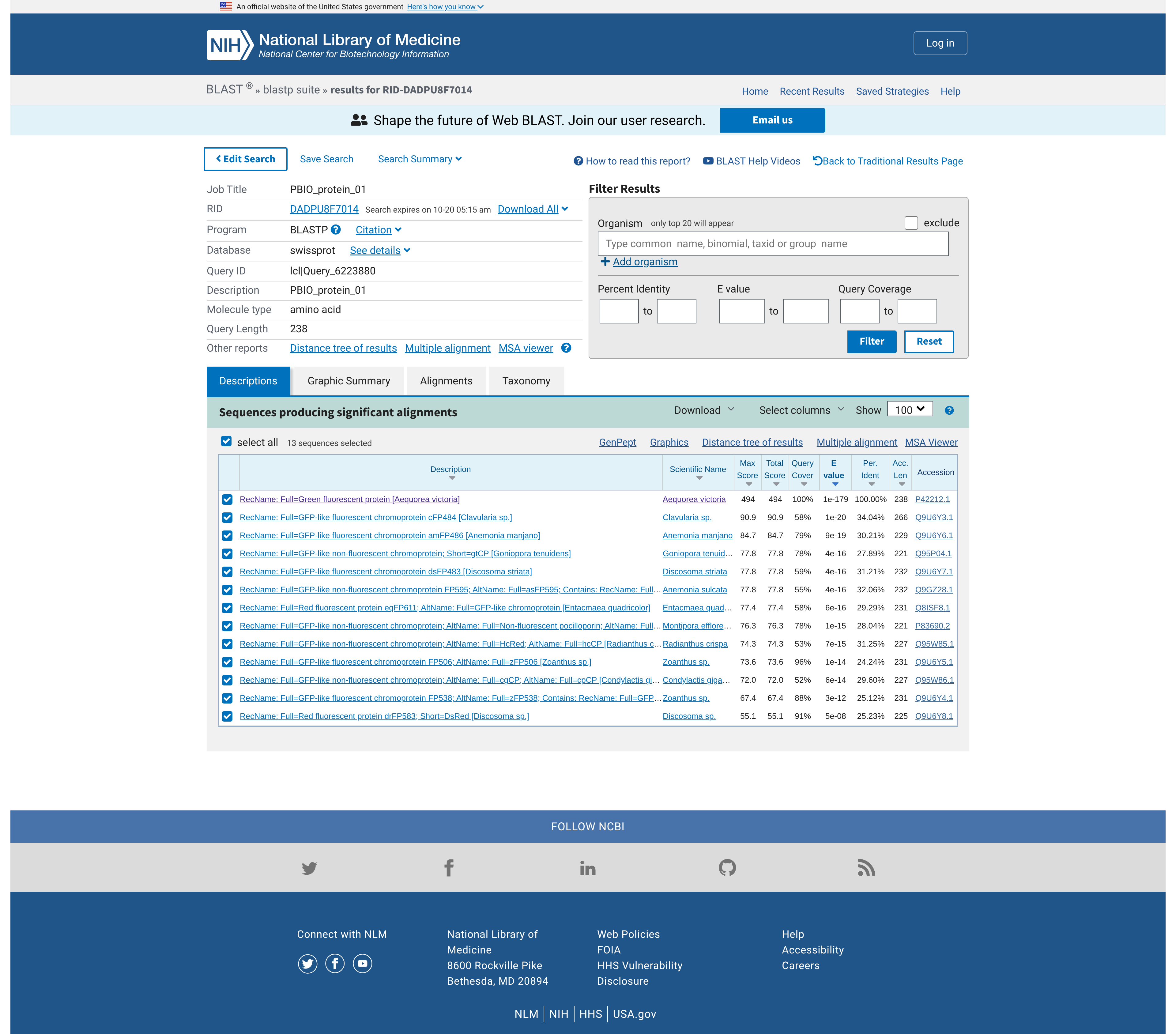
Querying Sequence P42212:
- Identified Protein: Green Fluorescent Protein (GFP) from jellyfish Aequorea victoria.
- Accession:
P42212.1(Swiss-Prot reviewed). - E-value interpretation: E-value =
0.0(statistically indistinguishable from zero, meaning probability of random chance match is negligible). - Query Cover vs Identity: Two sequences can share 100% identity over a tiny 20-amino acid domain, but have 10% query coverage overall. Always verify both metrics!
Watson-Crick Base Pairing Rules:
- $\text{A} \leftrightarrow \text{T}$ (2 hydrogen bonds), $\text{C} \leftrightarrow \text{G}$ (3 hydrogen bonds).
- Writing Reverse Complements: If input strand is $5'\text{-ATGCCG-}3'$, Watson-Crick complement is $3'\text{-TACGGC-}5'$. By convention, write $5' \to 3'$: $5'\text{-CGGCAT-}3'$.
- Double Stranded Stability: Sequences with higher GC content require higher temperatures to denature due to triple hydrogen bonding.
Information Flow & Codon Logic:
- $\text{DNA} \to \text{mRNA} \to \text{Polypeptide}$.
- The Stop Codon Trap: An mRNA with
5'-AUG-UUU-UAA-3'has 3 codons, but translates into 2 amino acids (`Met-Phe`), becauseUAAtriggers termination and does not add a residue. - Degeneracy: 64 possible triplet codons encode only 20 standard amino acids + 3 stop signals. Multiple codons specify the same amino acid.
Chromosome Counts & Punnett Risks:
- Human somatic cells: 46 chromosomes (23 homologous pairs: 22 autosomes + 1 sex chromosome pair).
- Gametes (sperm/egg): 23 chromosomes (haploid). Red blood cells contain 0 nuclear DNA.
- Mendelian Cross ($Aa \times aa$): Offspring risk of recessive phenotype ($aa$) is 50% ($0.5$).
Critical Real-World Genetics:
- Oxytocin Receptor (OXTR `rs53576`): Popular media labeled it "the empathy gene," but scientific meta-analyses showed associations are statistically weak or null. Complex traits are polygenic.
- CCR5-Δ32: 32-bp deletion causing frameshift; homozygous carriers lack surface CCR5 receptor, conferring resistance to common HIV-1 strains.
- King Richard III Mystery: mtDNA matched modern maternal descendants over 500 years; Y-chromosome STRs did not match due to a historical non-paternity event in the male lineage.
🚀 Launch Exercise 1 Workbook
Session ReadyThe interactive PBIO client-side workbook application runs directly in your browser. All answers, progress indicators, and hint logs are stored locally.
📦 Session Data & Fast Restores
Restore previous progress
If your browser session refreshes, you can load any of your completed .pbio session backups in the workbook:
- 💾
PBIO_01/PBIO_01_EN_s32484_1.pbio(Original full submission) - 💾
PBIO_01/assets/PBIO_01_EN_s32484_2.pbio(Checkpoint 2) - 💾
PBIO_01/assets/PBIO_01_EN_s32484_3.pbio(Checkpoint 3) - 💾
PBIO_01/assets/PBIO_01_EN_s32484_4.pbio(Checkpoint 4)
🔬 Complete Exercise 2 Solutions & Rationale
Code Implementation:
def get_complement(dna_seq: str) -> str:
"""Returns the complementary DNA strand (A<->T, C<->G)."""
trans_table = str.maketrans("ACGTUacgtuNn", "TGCAAaccaaNn")
return dna_seq.translate(trans_table)
user_sequence = input("Enter DNA sequence: ").strip()
complementary_dna = get_complement(user_sequence)
print("Complementary strand (3'->5'): ", complementary_dna)
print("Reverse complement (5'->3'): ", complementary_dna[::-1])Translated Amino Acid Sequence (Reading Frame +1):
MYSFVSEEIGTLIVNSVLLFLAFVVFLLVTLAILTALRLCAYCCNIVNVSLVKPSFYVYSRVKNLNSSRVPDLLVIdentified Organism & Protein:
Protein: Envelope small membrane protein (E protein)
NCBI Taxonomy ID:
2697049
Multiple Sequence Alignment (MSA):
Virus_1: MYSFVSEEIGTLIVNSVLLFLAFVVFLLVTLAILTALRLCAYCCNIVNVSLVKPSFYVYSRVKNLNSSRVPDLLV
Virus_2: MYSFVSEEIGTLIVNSVLLFLAFVVFLLVTLAILTALRLCAYCCNIVNVSLVKPSFYVYSRVKNLNSSRVPDLLV
Virus_3: MYSFVSEEIGTLIVNSVLLFLAFVVFLLVTLAILTALRLCAYCCNIVNVSLVKPTFYVYSRVKNLNSSRVPDLLV
:*******************S55T). Both are polar uncharged residues with hydroxyl (–OH) groups, representing a conservative substitution that preserves structural fold while marking a phylogenetic lineage split.
- Swiss-Prot (Reviewed): Manual curation by human experts integrating literature, function, and post-translational modifications.
- TrEMBL (Unreviewed): Automated computational translations of submitted EMBL/GenBank/DDBJ sequences without human review.
- The "Reviewed" Fallacy: Reviewed does NOT guarantee wet-lab validation; always inspect the Evidence Code tag!
- GenBank: Direct author submissions. Letters + numbers without underscores (e.g.
U50222.1). Highly redundant, immutable archives. - RefSeq: Curated reference models. Always contains an underscore:
NM_(mRNA),NP_(Protein),NC_(Complete chromosome),NG_(Genomic region). Non-redundant.
- Coordinates change across genome builds! GRCh38 (hg38) has different chromosomal start/end positions from GRCh37 (hg19).
- BioMart uses Filters to narrow candidate entities and Attributes to choose output columns.
- PDB Resolution: Measured in Ångströms ($\text{Å}$). Lower is better ($<1.5\,\text{Å}$ atomic resolution; $>3.0\,\text{Å}$ low resolution).
- AlphaFold pLDDT Score: Confidence metric from 0 to 100. Residues with $\text{pLDDT} < 50$ indicate Intrinsically Disordered Regions (IDRs) that lack rigid structure in solution.
📋 Exercise 2 Key Reference Sheet
Essential facts for tests and lab credit
Human: organism_id:9606 · SARS-CoV-2: taxid:2697049 · Jellyfish Aequorea victoria: taxid:6100. Always filter by TaxID to prevent text ambiguity errors.
NM_ = Curated mRNA · NP_ = Curated protein · NC_ = Complete chromosome · XM_ / XP_ = Model computationally predicted.
GSE = Series study · GSM = Individual biological sample · GPL = Platform technology (microarray or sequencing machine).
1 Gene locus $\to$ Multiple alternative transcript variants $\to$ Multiple distinct protein isoforms. Joining gene IDs to protein IDs multiplies rows!
📁 Exercise 2 Submission Files
Generated and stored in repository🗄️ Primary Biological Databases Map
Two main sections: Swiss-Prot (reviewed by professional biocurators) and TrEMBL (unreviewed computational translations). Use organism_id:9606 for human.
GenBank: Archival repository of researcher-submitted sequences. Immutable, high diversity.
RefSeq: Curated, non-redundant reference genomes and standards.
Atomic coordinates $(x,y,z)$. PDB contains experimentally solved structures (X-ray, Cryo-EM, NMR). AlphaFold DB contains deep learning predicted structures accompanied by pLDDT confidence scores.
Functional genomics repository. Organised into GSE (Series study), GSM (individual sample), and GPL (platform assay).
🐍 Python API Scripting & Automation
Query UniProtKB programmatically for reviewed human proteins and parse into a Pandas DataFrame:
import urllib.request
import pandas as pd
import io
# UniProtKB REST search endpoint for human reviewed proteins
url = (
"https://rest.uniprot.org/uniprotkb/search?"
"query=organism_id:9606+AND+reviewed:true&"
"format=tsv&"
"fields=accession,id,protein_name,gene_names,length&"
"size=100"
)
headers = {"User-Agent": "PBIO_Study_Hub/1.0 (s32484@pjwstk.edu.pl)"}
req = urllib.request.Request(url, headers=headers)
with urllib.request.urlopen(req) as response:
if response.getcode() == 200:
tsv_data = response.read().decode("utf-8")
df = pd.read_csv(io.StringIO(tsv_data), sep="\t")
print(f"Downloaded {len(df)} records:")
print(df[["Entry", "Length", "Gene Names"]].head())User-Agent with your contact email so database administrators can notify you instead of blocking your IP during high-throughput queries.
📖 Comprehensive Bioinformatics Glossary
Standard text format for nucleotide or peptide sequences. Line 1 begins with > and contains the identifier; subsequent lines contain single-letter sequence codes.
The number of random alignments with a score $\ge S$ expected by chance in a database search. Values approaching 0.0 denote non-random, biologically significant matches.
The percentage of the input query sequence covered by the alignment hit. A 100% identity hit with only 15% query cover may indicate an isolated structural motif rather than true gene homology.
Predicted Local Distance Difference Test (0–100). Measures structural confidence per residue. $>90$ is very high; $<50$ frequently correlates with naturally intrinsically disordered regions (IDRs).
Tandemly repeated 2–6 base pair motifs (microsatellites). The number of repeats varies between individuals, forming the basis for forensic DNA profiling (CODIS markers).
Circular genome (~16.6 kb in humans) housed in mitochondria. Inherited strictly maternally without meiotic recombination, enabling genealogical tracing across hundreds of years (e.g. Richard III).
General Feature Format v3. A standard 9-column tab-delimited file describing genomic features (genes, exons, CDS) using 1-based inclusive coordinates.
Web and programmatic query interface for mining genomic attributes without SQL. Allows users to specify Filters (e.g., Chromosome 21) and Attributes (e.g., Gene ID, Ensembl Transcript ID).
UniProt Reference Clusters. Groups sequence fragments sharing $\ge 100\%$, $90\%$, or $50\%$ identity into single representative entries, accelerating computational searches.
🎯 Interactive PBIO Mastery Quiz
0.005, but only 12% Query Coverage. What is the most scientifically sound conclusion?
5'-AUG-UGG-GAA-UAA-3'. How many amino acids will be in the peptide chain synthesized by the ribosome?
organism_id:9606 rather than searching the text word "human"?
pip install biopython in your terminal. How must you import Biopython modules in your Python script?
SeqIO.parse() and SeqIO.read() in Biopython?
🎙️ Audio Deep Dive Studio
Episode 1 · Foundations of Bioinformatics & Exercise 1 Gotchas
Listen to the dramatized conversation between senior bioinformatician Dr. Alex and CS student Sam breaking down DNA structure, stop codons, and BLAST query coverage.
📄 Script Transcript Preview
🤖 Generate Authentic Audio in NotebookLM
NotebookLM generates conversational, podcast-style audio discussions between two AI hosts. We have prepared specialized, prompt-engineered source briefing packs in your workspace:
Includes DNA chemistry, reverse complement rules, stop codon traps, Richard III genealogy, and BLAST query coverage vs identity.
Includes Archives vs Curated databases, the "Reviewed" fallacy, row multiplication in 1-to-many joins, organism_id:9606, and Term Projects.
Includes Biopython SeqIO, coordinate slicing (0-based vs 1-based), memory-safe gzip streaming, REST API pagination, and project pipeline design.
Quick Generation Steps:
- Go to notebooklm.google.com and click Create new notebook.
- Click Add Sources $\to$ select Paste text.
- Click the copy button above, paste the text into NotebookLM, and save.
- Under Notebook Guide (top right), click Generate next to Audio Overview.
- In ~2 minutes, your AI audio podcast will be ready to stream or download!